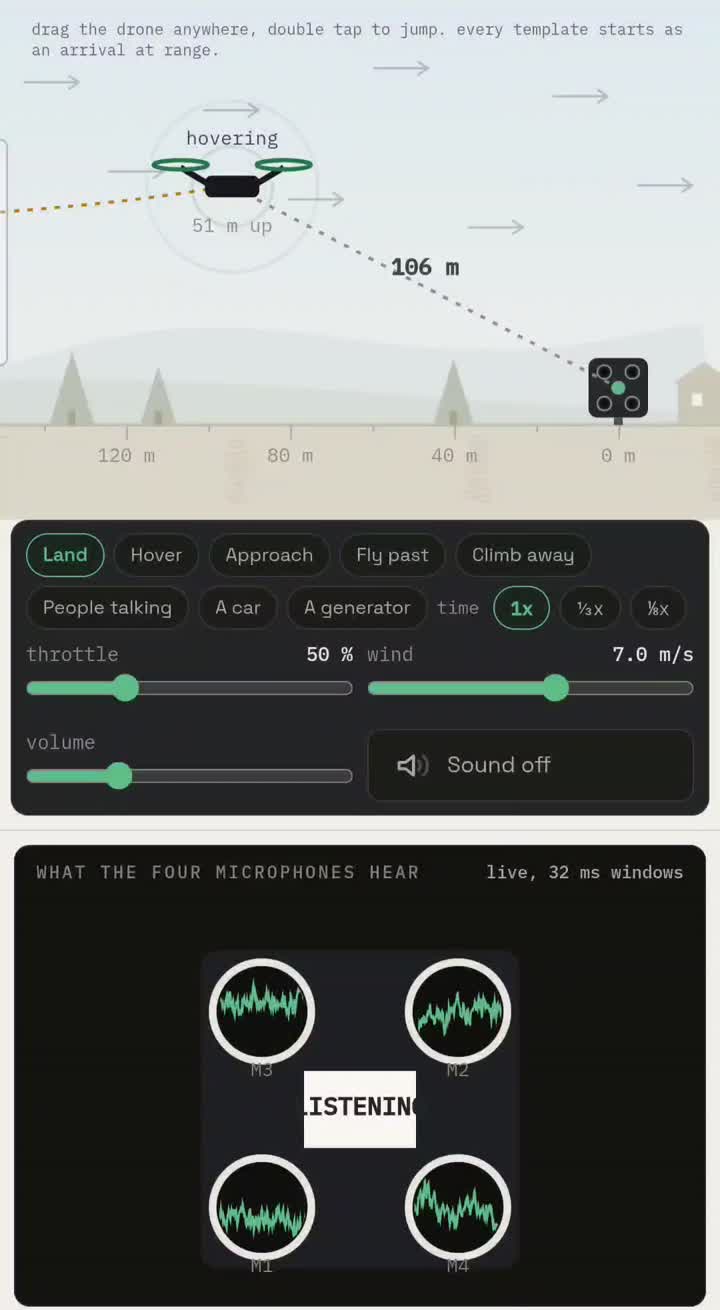
Radio-based drone detection has a blind spot: it only works if the drone transmits. Fibre-optic FPV drones don't. Control and video run down a physical cable, so the radio spectrum stays completely silent. No signal to catch, no link to decode. Agam Rossen's VolAnti takes a different approach: it listens. Four MEMS microphones pick up the harmonic comb that spinning propellers always produce, a signature that physics won't let a drone hide, regardless of how it's controlled.
The hardware is refreshingly simple: an ESP32-S3, e-paper display, and LoRa radio in a 91mm box, and fully open source.
What's been reported from testing:
→ 104 m detection range in quiet conditions
→ 0.23 s alarm latency on its fastest tier
→ 18 to 22 hours on a single charge
→ Zero false alarms in field sessions so far
This same physics is the foundation of what we are building at DroSonic. A propeller cannot suppress its own blade passage tones and harmonics no matter how the drone is controlled. We are developing a passive acoustic counter-UAS detection and cueing system that classifies and localizes threats on an edge AI device with zero RF emissions and no cloud dependency. Seeing independent open-source work converge on the same acoustic principle is a strong signal that this approach is worth pursuing.
#AcousticSensing #DroneDetection #OpenSource #CounterUAS #EdgeAI #DroSonic