
Prisons don't just need to know a drone flew over.
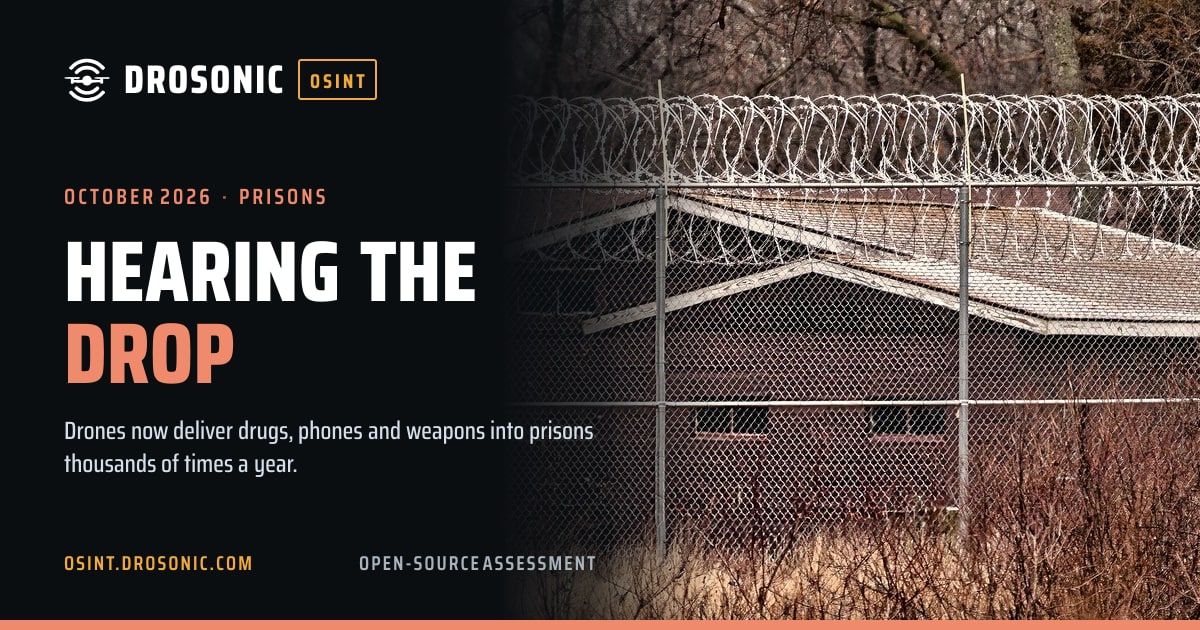
Prisons don't just need to know a drone flew over. They need to know if it dropped something and where.
Drone deliveries over prison walls are now routine:
▪ 1,712 drone incidents at prisons in England and Wales in one year (up 43%)
▪ 1,064 at Canada's federal prisons (2024–25)
▪ 479 at U.S. federal prisons in 2024, up from 23 in 2018
In the UK, the Chief Inspector of Prisons said the airspace above two high-security prisons had "in effect" been ceded to organised crime gangs.
Most prisons can't jam or shoot these drones down. Their real defence is to detect the drone and recover the package before a prisoner does. Radio detectors can say a drone is near, but not whether it dropped anything, and they struggle with encrypted or pre-programmed flights.
A February 2026 study from Université de Sherbrooke found a new answer in the sound. When a drone releases a 500–600 g package, its propellers slow and their pitch drops. A ground microphone array heard that change in 96% of test drops, with false alarms in 8% of moments.
It's early work: one drone model, heavy loads, and a range of about 100 m. But it targets the gap prisons most need closed: the moment of the drop.
In the latest DroSonic OSINT assessment, I set out:
- the scale of the problem in the UK, Canada and the U.S.
- why prisons can't simply jam or shoot
- what each sensor tells staff at the wall, and what it misses
- what acoustic detection can and can't do yet
Every claim is sourced. Full report (free, with a PDF):
https://lnkd.in/gVzQ6W5c
#CounterUAS #DroneDetection #CorrectionalSecurity #PrisonSecurity #AcousticSensing #Contraband #PublicSafety #DefenseTech #OSINT #DroSonic